-
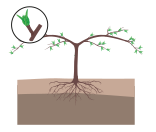
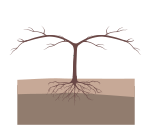
DORMANCY
-
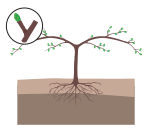
BUD SWELLING
-
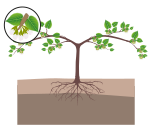
LEAF EMERGENCE
-
INFLORESCENCE EMERGENCE
-
FLOWERING
-
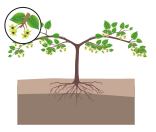
FRUIT SET
-
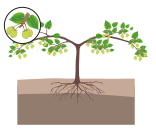
FRUIT DEVELOPMENT
-
MATURITY
-
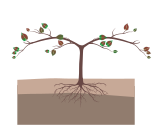
POST-HARVEST
Basic fertilization
Hydro-soluble fertilizers
Root-applied biostimulants
Foliar biostimulants
Post harvest
KIWI CULTIVATION SYSTEMS IN GREECE
Kiwi cultivation in Greece began in the 1970s in Pieria and has since expanded rapidly across the country, particularly in regions such as Imathia, Pella, Arta, Kavala, Xanthi, and Larissa. Kiwi thrives in temperate climates, with sufficient winter chilling hours and warm summers without extreme temperatures.
Key agronomic requirements for successful kiwi cultivation:
- Deep, fertile, and well-drained soils
- High organic matter content
- Protection from strong winds and late spring frosts
- Reliable irrigation system (preferably drip irrigation)
- Proper canopy and vegetative growth management
Kiwi is a vigorous climbing plant with strong vegetative growth and requires robust support systems (such as pergola or T-bar structures), as well as precise winter and summer pruning to achieve a balance between vegetative growth and fruit production.
KIWI VARIETIES
The dominant commercial variety in Greece is Hayward, which is characterized by large oval fruits, brown fuzzy skin, and high sugar content.
At the same time, the early variety Tsechelidis also holds a significant share in the green kiwi market. It is characterized by less fuzz compared to Hayward, large fruit size, uniform shape, better durability, and improved post-harvest storability.
Both types require specialized fertilization and irrigation programs, effective pollination, and a healthy root system in order to fully exploit their genetic potential in terms of yield and quality characteristics.
In recent years, the market for yellow kiwi has also been growing in Greece. Varieties such as Zespri Gold and Jingold have attracted interest due to their excellent sweetness, early production, and slightly greater tolerance to warmer conditions.
FERTILIZATION AND IRRIGATION MANAGEMENT
Kiwi is considered a crop with high requirements in nutrients and water. Balanced nutrition is essential for vegetative growth, flowering, fruit set, and the final size and weight of the fruits.
Key nutritional priorities:
- Adequate nitrogen (N) for vegetative growth
- Potassium (K) for fruit quality and sugar content
- Calcium (Ca) and boron (B) for fruit set and firmness
- Consistent and uniform irrigation to avoid water stress
Fertigation is widely applied, allowing precise and targeted nutrient supply according to the plant’s phenological stage.
FREQUENTLY ASKED QUESTIONS ABOUT KIWI
When is kiwi harvested in Greece?
Kiwi is harvested in autumn, usually from October to November, when the required levels of sugars (°Brix) and dry matter are reached.
How many years does it take for kiwi to bear fruit?
Kiwi plants begin producing fruit after 3–4 years, while full production is typically achieved in 6–7 years.
What is the best fertilization program for kiwi?
A comprehensive program includes basic fertilization, fertigation during the growing period, and the application of biostimulants and nutrients such as boron and calcium to improve fruit set and quality.
Does kiwi require a lot of water?
Yes. Kiwi has high water requirements, especially during flowering and fruit development. Regular irrigation is essential to avoid yield losses.
What soil is suitable for kiwi cultivation?
Deep, fertile, well-drained soils with high organic matter content and a slightly acidic to neutral pH are preferred.
Is pruning important in kiwi cultivation?
Yes. Proper pruning is a prerequisite for good production and correct plant formation, as it regulates vegetative growth, improves canopy light penetration, and contributes to larger and more uniform fruits.
What are the main challenges in kiwi cultivation?
Common problems include root asphyxia due to poor drainage, root infections caused by pathogenic fungi, frost damage, nutrient deficiencies (mainly iron and micronutrients), and water stress.