

-
Emergence
-
4-Leaf Stage (V3)
-
6-Leaf Stage (V6)
-
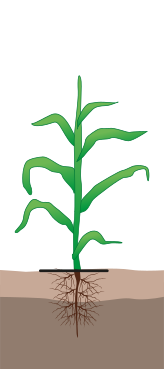
10-Leaf Stage (V10)
-
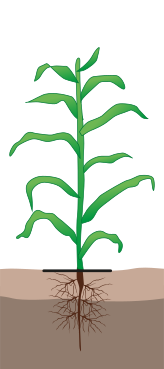
Tasseling
-
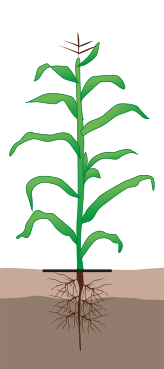
Silking
-
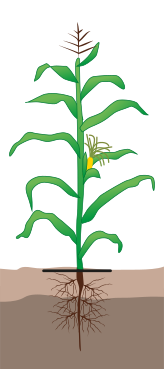
Grain Filling
-
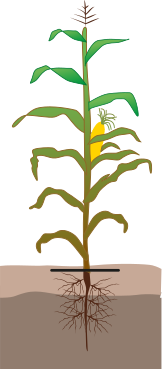
Maturity
Basic fertilization
Top-dress fertilization
Root applied biostimulants
Foliar biostimulants
Maize is one of the most important field crops in Greek agriculture, offering high yield potential while requiring precise nutrient and fertilization management.
Achieving consistent and high yields depends on a comprehensive maize fertilization program tailored to Mediterranean growing conditions, where drought, high temperatures, and soil limitations directly affect crop growth and productivity.
TIMAC AGRO supports maize growers with advanced plant nutrition technologies and specialized agronomic expertise, helping to secure stable yields while maximizing input efficiency and return on investment.
MAIZE NUTRITIONAL REQUIREMENTS
Maize is a crop with high nutrient requirements, characterized by rapid biomass accumulation and intensive nutrient uptake throughout its growth cycle.
The main physiological requirements of the crop include:
- Early root development and establishment to ensure efficient nutrient uptake.
- Vigorous vegetative growth to support the formation of productive ears.
- Optimal flowering and fertilization for maximum kernel set.
- Enhanced tolerance to water deficit and heat stress conditions.
A balanced plant nutrition program is essential for uniform crop establishment and the full expression of yield potential. Adequate and balanced nutrient supply from the early growth stages promotes root system development, improves plant vigor, and creates the conditions necessary for achieving high yields and superior grain quality at harvest.
OPTIMIZED MAIZE NUTRITION STRATEGY
SOIL FERTILITY AND PHOSPHORUS LIMITATIONS
Many agricultural soils in Greece are characterized by:
- Alkaline pH.
- High calcium carbonate (CaCO₃) content.
- Low phosphorus availability.
These conditions promote phosphorus fixation in the soil, reducing its availability for plant uptake during the early stages of crop development.
With MPPA DUO technology, TIMAC AGRO helps:
- Increase phosphorus availability, even in challenging soil conditions.
- Enhance root system development.
- Improve crop establishment and early-season growth.
- Unlock and remobilize nutrients fixed in the soil.
Early and uniform crop development is a key factor in maximizing maize yield potential and achieving consistent field performance.
BIOSTIMULATION AND DROUGHT MANAGEMENT
Drought is one of the major limiting factors affecting maize production in Greece.
The most critical growth stages are:
- Stem elongation.
- Flowering (a particularly sensitive stage).
- Grain filling.
Biostimulants powered by SEACTIV technology help:
- Promote root growth and improve soil exploration by the root system.
- Enhance the efficient use of available water.
- Increase plant tolerance to high temperatures and water stress.
- Maintain optimal photosynthetic activity under challenging growing conditions.
Improved resilience during critical growth stages helps preserve yield potential and supports more stable crop performance under drought conditions.
NITROGEN MANAGEMENT
Nitrogen is the most important nutrient driving maize productivity. However, under Greek growing conditions, significant nitrogen losses can occur due to:
- Volatilization caused by high temperatures.
- Leaching resulting from irrigation or heavy rainfall events.
Key nitrogen management practices include:
- Splitting nitrogen applications between basal and top-dress fertilization.
- Synchronizing nitrogen supply with crop demand, particularly from the V6 growth stage through flowering.
TIMAC AGRO’s MPPA DUO technology helps ensure:
- Controlled nitrogen release.
- Reduced nutrient losses.
- Continuous nutrient availability throughout critical growth stages.
The resulting benefits include:
- Enhanced biomass production.
- Improved grain filling.
- Greater nitrogen use efficiency.
SELECTING THE RIGHT FERTILIZER FOR MAIZE
Selecting the right fertilizer for maize is a key factor in achieving high yields under Greek growing conditions.
A comprehensive fertilization program should provide:
- Nitrogen (N) → the primary driver of crop productivity.
- Phosphorus (P) → essential for root system development.
- Potassium (K) → supports water balance regulation and stress tolerance.
- Sulfur (S) → required for protein synthesis.
- Zinc (Zn) → a critical micronutrient during the early stages of crop development.
In many regions of Greece, particularly in calcareous and alkaline soils, zinc deficiency is a common yield-limiting factor. Ensuring adequate zinc availability is therefore essential for optimal crop establishment, vigorous early growth, and maximizing yield potential.
KEY AGRONOMIC PRACTICES
PLANTING CONDITIONS AND CROP ESTABLISHMENT
Successful crop establishment requires:
- Soil temperatures above 10–12°C.
- Uniform planting depth.
- A well-prepared seedbed.
- Rapid and uniform crop emergence.
Early crop establishment is critical for maximizing yield potential, as it promotes uniform plant development and lays the foundation for optimum productivity throughout the growing season.
IRRIGATION AND WATER MANAGEMENT
In Greece, maize is predominantly cultivated under irrigated conditions.
Key recommendations include:
- Avoiding water stress during the flowering stage.
- Optimizing irrigation frequency and water application rates.
- Integrating irrigation and nutrient management whenever possible through fertigation.
Efficient water management significantly enhances nutrient uptake, improves crop performance, and contributes to more stable and consistent yields.
SENSITIVITY TO STRESS CONDITIONS AND NUTRIENT DEFICIENCIES
Maize cultivation in Greece is highly sensitive to several limiting factors associated with Mediterranean climatic conditions and soil characteristics.
Water stress is one of the most significant challenges, as insufficient water supply during critical growth stages can substantially reduce kernel set and the number of developing grains.
Nitrogen deficiency is also a common issue in many Greek soils, restricting vegetative growth, reducing biomass production, and ultimately limiting yield potential.
In addition, zinc deficiency is frequently observed in calcareous and alkaline soils, leading to poor early plant development and reduced crop vigor during the establishment phase.
For this reason, effective irrigation management and balanced fertilization programs that include both macronutrients and micronutrients are essential for optimizing maize production.
A well-balanced nutrient management strategy helps maintain crop uniformity, enhances plant resilience, and supports the achievement of high and consistent yields.
FREQUENTLY ASKED QUESTIONS ABOUT MAIZE
When Is Fertilization Applied in Maize?
Fertilization is typically carried out through a basal application before or at planting, followed by a nitrogen top-dress application approximately 4–6 weeks after crop establishment.
How Much Water Does Maize Require?
Maize has high water requirements, particularly during flowering and grain-filling stages, when irrigation demand is at its peak. Adequate water availability during these critical growth periods is essential for maximizing kernel set, grain development, and overall yield potential.
What Are the Essential Nutrients for Maize?
The most important nutrients for maize are nitrogen (N), phosphorus (P), potassium (K), and zinc (Zn). These nutrients play a critical role in supporting root development, vegetative growth, stress tolerance, and grain production, ultimately determining the crop’s yield potential.
How Does Drought Affect Maize Yield?
Drought limits nutrient uptake, reduces photosynthetic activity, and directly affects kernel set and final crop yield. As a result, prolonged water stress during critical growth stages can significantly compromise maize productivity and yield potential.